The benefits of journalling, and twenty prompts to begin
 Lyndall Thomas

How journalling helps us process our thoughts, how to find the time, and twenty reflective journal prompts to help you begin.
6a13dee9065be_lg.png)
For me, there's a particular kind of thinking that only happens when I put pen to paper.
I find that it’s important to have different journals for different types of thoughts – an inexpensive one for ranting, a fancy one for more formal processes, like courses, my gratitude practice or targeted transformation work. In some periods of my life, I’ve committed to Julia Cameron’s ‘Morning Pages’ practice, and I’ve also used journals in more ad hoc ways to support me through various challenges.
What the research says
There's plenty of research behind why journalling works. Psychologist James Pennebaker's work on emotional disclosure suggests that writing about what's difficult helps organise chaotic thoughts and release what we're carrying, which over time supports mental clarity and resilience. A well-known review by researchers Baikie and Wilhelm backs this up, linking regular journalling to better mood, sharper emotional awareness and lower stress. The mechanism is fairly simple, even if the science behind it isn't: a thought that keeps circling in your head can lose some of its grip once it's out on the page.
Finding the time
If you're a busy woman reading this and thinking I don't have time to journal, you're not alone, and I don't think the answer is to find more time. It's to lower the bar on what counts.
Some people find clarity first thing in the morning, before the day has had a chance to ask anything of them. Others find they have more to say at night, once the day is done and there's finally room to process it. The research doesn't land firmly on one being better than the other – what matters more is consistency over duration. A few honest minutes with your morning coffee, or a few lines before you turn off the lamp, does more over months than an elaborate routine you abandon after a week.
There's no perfect time to start. There's only the next quiet moment you're willing to give yourself.
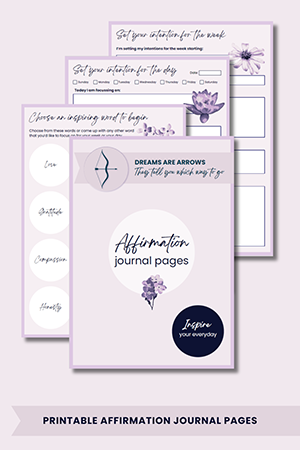
If you’re looking for inspiration, our affirmation journal pages are a brilliant starting point. You can print out as many pages as you need (for days or a week) and you can pair your journal reflections with affirmations.
And below you’ll find twenty reflection prompts to get you started, grouped loosely by theme. Taking just a few moments to reflect on a prompt and jotting down your thoughts can help you consolidate your interior work.
Reflective journal prompts
Identity and roles
- What part of yourself do you set aside when you're busy taking care of everyone else?
- If no one was watching, what would you do differently today?
- What did you love doing before you learned to be practical about it?
Boundaries and energy
- What's one thing you keep saying yes to that you'd like to say no to?
- Whose opinion of you do you weigh more heavily than your own?
- Where in your life are you giving more than you're receiving?
Comparison and social media
- What would you stop scrolling for?
- Whose life have you been quietly measuring yourself against?
- What's true about your life that a photo could never capture?
Money and worth
- What story about money did you inherit without ever choosing it?
- What would change if you believed you already had enough?
Time, slowness and rest
- What would your week look like if you stopped optimising it?
- When did you last do something with no outcome in mind?
Courage and change
- What's one small brave thing you could do this week?
- What are you waiting to feel ready for, that you could begin anyway?
Creativity and voice
- What have you always wanted to make, and what's stopping you?
- When do you feel most like yourself?
Belonging and home
- What does home feel like in your body, not just your address?
- Who do you feel most like yourself around?
Seasons and change
- What season of life do you feel you're in right now, and how does it feel to name it?
There's no right way to work through these. Some will open something up straight away. Others might sit unanswered for weeks before you're ready for them, and that's fine too. The point was never to finish the list.
If you'd like a more guided place to start, our free resource Thriving is my birthright takes a similar approach – gentle prompts, no pressure, just space to notice what's already true for you. It’s purposefully designed for those who feel stuck in survival mode and, through a guided journalling practice, leads you towards the conditions that will help you to thrive.
May you find your way home to yourself.

Categories: : Journalling