Recognising your Higher Self
 Lyndall Thomas

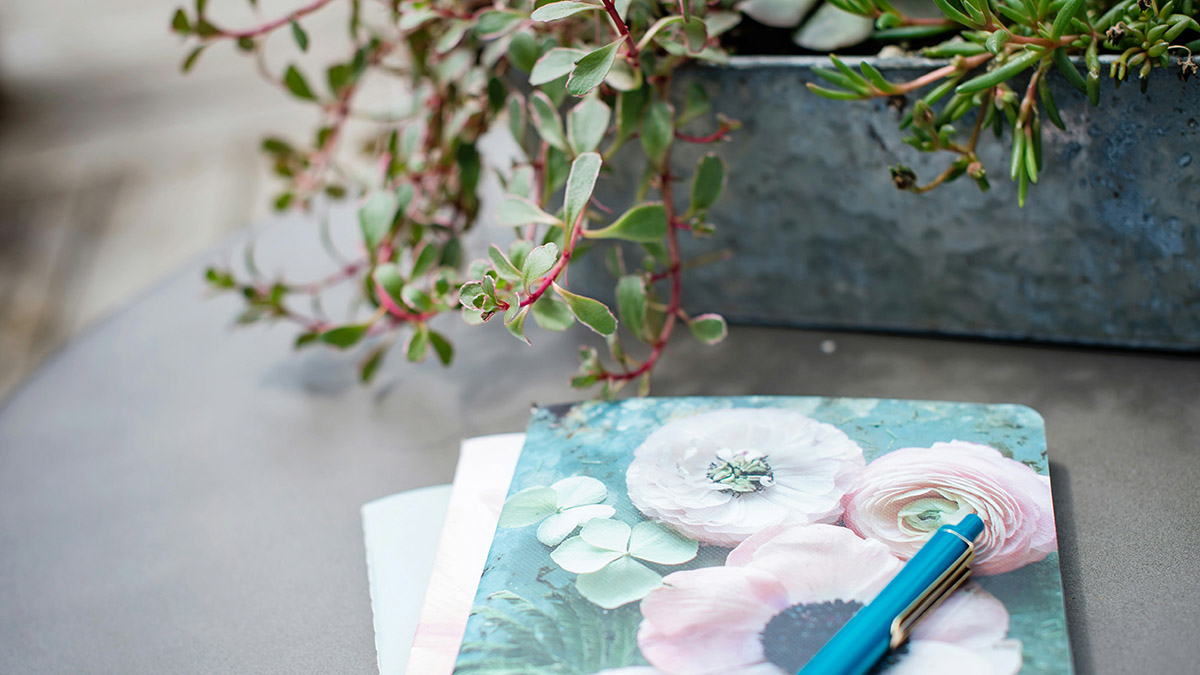
How do you tell which of your thoughts to trust? In this post, I share how journalling and self-compassion help me recognise my Higher Self and follow my intuition.
Have you ever wondered which of your thoughts belong to the ‘real’ you? You’ve probably come across the term ‘Higher Self’ along the way, but what does it actually mean? And how are we supposed to follow our intuition when it’s so hard to tell which thoughts to trust?
For me, learning to understand and follow the guidance of my Higher Self has taken practice – and a lot of journalling. As I write, my fears and negativity pour out onto the page. Words like ‘failure’, ‘idiot’ and ‘loser’ show up often. With that process comes observation – oh, there I am, beating myself up again – and from there, I can start being kind to myself.
Kindness turns out to be the doorway. It’s hard to hear the Higher Self over a spiral of self-blame and recrimination, and self-compassion is what quietens my mind enough to listen.
In this blog, I’ll share some ways to recognise your Higher Self, leading to a stronger ability to trust your intuition.
6a13dee9065be_lg.png)
How to tell which voice is which
I’m a huge fan of the work of brain scientist Dr Jill Bolte Taylor. In her book, Whole Brain Living, she describes the mind as a group of characters, each with its own job and its own way of seeing the world. Being able to identify the characters allows us to see them as they are – the analyser, the worrier, the connector and the joy seeker.
I have loved doing this work, identifying and naming my characters, and learning when to let each one step up and contribute to my thoughts.
And then I’ve taken this further. I’ve named the observer – the one who can identify thoughts, and name the parts of myself – as the Higher Self. For me, it becomes possible to shift from being ‘in character’ (such as when my worrier goes into overdrive) to being my Higher Self.
When I make this shift, I notice an immediate difference: I feel calm and unhurried, and I trust myself.
A question that can help you tell the difference is whether the guidance in your head feels like it’s trying to protect you – or trust you.
If this sounds intriguing to you, I’d like to invite you to explore our guide, Following the arrow. In the guide, we look at this idea at a deeper level. We name our characters and we use journalling to explore what our Higher Self wants for us. It’s a fulfilling experience that can help you live in a more connected, intuitive way.
There are also some helpful tips for staying connected with the Higher Self because, as we all know, when life gets busy and demanding, it can be easy to slip back into habitual ways of being – including being hard on yourself.
Find your intuition through kindness
When we speak to ourselves harshly (with those words like ‘loser’ and ‘idiot’), it becomes harder to hear our intuition. Self-compassion is integral to shifting into the observer mode of the Higher Self.
You can see this in action in the journalling example I shared above. With the observation of my thoughts – oh, there I am, beating myself up again – I open the door to the Higher Self. I don’t have to layer the observation with judgement. I can just notice how I’m treating myself.
A few journal prompts
If you’d like to try this for yourself, here are a few prompts to write on. Go gently, and there’s no need to answer them all.
- When my inner critic is loudest, what words does it use?
- What would I say to a friend who spoke to themselves this way?
- Which character is in the driving seat right now, and what does it need from me?
Come back to yourself
The next time you catch yourself mid-spiral, try saying it gently: oh, there I am. That small moment of noticing is where the Higher Self steps in.
If you’d like to practise being kinder to yourself, I’d love you to listen to the meditation ‘I can be kind to myself’. It’s one of my favourites – short and sweet, and it brings me gently into self-compassion when my inner critic is in overdrive.
May you find your way home to yourself.

Categories: : Journalling, Meditation